I've Got Some Bad News, and I've Got Some Good News (Brief Edition)


First, the bad news.
However, you don't have to be depressed about it.
Labels: Climate change, Drugs, nerd shit, Science
posted by Jude at 7:14 PM

Gumbo and Beignets
Labels: Climate change, Drugs, nerd shit, Science
posted by Jude at 7:14 PM

posted by Jude at 8:08 PM

posted by Jude at 8:18 AM

Labels: nerd shit
posted by Jude at 7:32 PM

<'kylev> BAHAHAHAHAHAHAHAHAThere's lots of good stuff there. Check it out. Your boss won't mind at all.
<'kylev> hahahahaha
<'kylev> some girl just came onto our floor
<'kylev> and was yelling "sexual favors for anyone who does my sociology paper"
<'kylev> i just asked her what the paper was about
<'kylev> and she said the accomplishments and growth of feminism
<`Neo> bahahahaha
posted by Jude at 10:26 AM

The European Space Agency (ESA) on Tuesday called for applications for one of the most demanding human experiments in space history: a simulated trip to Mars in which six "astronauts" will spend 17 months in an isolation tank on Earth.
Their spaceship will comprise a series of interlocked modules in an research institute in Moscow, and once the doors are closed tight, the volunteers will be cut off from all contact with the outside world except by a delayed radio link.
They will face simulated emergencies, daily work routines and experiments, as well as boredom and, no doubt, personal friction from confinement in just 550 cubic metres (19,250 cubic feet), the equivalent of nine truck containers.
Communications with the simulated mission control and loved-ones will take up to 40 minutes, the time that a radio signal takes to cross the void between Earth and a spaceship on Mars. Food will comprise mainly the packaged stuff of the kind eaten aboard the
International Space Station (ISS).
The goal is to gain experience about the psychological challenges that a crew will face on a trip to Mars.
Four of the crew will be Russian, and two will come from countries that are members of ESA, agency and Russian officials said at the Paris Air Show in Le Bourget.
In all, 12 European volunteers are needed.
A precursor 105-day study is scheduled to start by mid-2008, possibly followed by another 105-day study, before the full 520-day study begins in late 2008 or early 2009.
--snip--
The terrestrial Mars-stronauts will not get much glory for their confinement, nor will they get particularly rich.
They will get paid 120 euros (158 dollars) a day, said Marc Heppener of ESA's Science and Application Division.
posted by Jude at 11:38 AM

US researchers have identified microscopic traces of soft tissue taken from a 68 million-year-old T-rex fossil in a startling discovery that is yielding clues to evolutionary links between dinosaurs and birds, a study released Thursday said.Sixty-eight million year old soft tissue? Amazing.
The tiny protein fragments were extracted from the leg bone of a Tyrannosaurus rex that was discovered in the western state of Montana in 2003, but it wasn't until recently that scientists were able to definitively identify them as traces of prehistoric dinosaur collagen.
The collagen should have degraded millions of years before according to conventional wisdom, but paleontologists at North Carolina State University were fairly confident that what they had was the "barely detectable" remains of dinosaur soft tissue based on their chemical and molecular analyses.
However, they could not definitively say that, so they turned to biochemist John Asara at Beth Israel Deaconess Medical School in Boston to make that determination.
It took Asara a year and a half, but he was finally able to sequence the amino acids in the collagen proteins - a proxy for DNA analysis - and conclude that the T-rex femur did indeed contain traces of collagen, a fibrous protein found in bone.
When the researchers compared those amino acid sequences to those of similar proteins in several contemporary animals, they found that the T-rex sequence had similarities to those of chickens, and to a lesser extent frogs and newts.
That finding bolsters a recent and controversial proposal that birds and dinosaurs are evolutionarily related, and change that hypothesis to a theory, the researchers said.
posted by Jude at 1:02 PM


posted by Jude at 2:46 PM

Rain KO'd Interceptors During Korea Missile Tests (Updated)One thing I kind of miss about the military is the way they can euphemize just about anything. Next time your house gets flooded, call the insurance company and tell them you've had a "water intrusion." Shit, you could probably get the local news to do a feature on you if you used a phrase like that.
Torrential rains wiped out a quarter of the U.S.' intercontinental ballistic missile interceptor silos in Ft. Greely, Alaska last summer -- right when North Korea was preparing to carry out an advanced missile launch, according to documents obtained by the Project On Government Oversight.
"The flooding occurred during a three-week period between the end of June and early July 2006," POGO notes, in a statement. "The flooding damaged 25% of the U.S. interceptor missiles’ launch capability. These silos house the interceptor missiles that would be used to attempt to intercept a missile aimed at the United States. No interceptors were in the flooded silos."
An internal assessment by Boeing, the silos' chief contractor, shows seven flooded interceptor silos, out of the 26 at Ft. Greely. Two silos have more than 62 feet of water; a third has more than 50. Estimated times of repair range from four to 14 months. Boxcar like structures called Silo Interface Vaults (SIVs), adjacent to the interceptor silos, were also flooded, "two of them by as much as 15 feet of water," POGO says. "Three SIVs must have all electronic and mechanical systems replaced. Four other SIVs have partial damage. One SIV was so damaged that it shifted vertically in the ground like a house shifting off its foundation." It's a strange turn of events, considering "an environmental impact study of the facilities at Ft. Greely notes there is 'little rainfall in the region.'"
The "water intrusion... resulted from the confluence of several unanticipated and highly unlikely events," the Missile Defense Agency said in a statement . "In particular, totally unprecedented rainfall created a rapidly rising ground water condition coincident with steps of construction when the SIVs were susceptible to damage. The Missile Defense Agency allocated resources to repair the damage and recover from the event. Furthermore, steps have been taken to prevent recurrences in the future."
POGO blames Boeing for being "at least partly responsible for failing to protect the silos" from the elements. Nevertheless, the watchdog group observes, the company "will most likely still receive an estimated $38 million to repair the silos and a $100 million no-bid contract to build more silos. Boeing would also receive a $7 million award fee added to the contract."
But the larger issue at work here is: What exactly are we getting, for the $9 billion a year we're paying for missile defense? And why can't it take alittle(ok, a whole bunch of) rain?
UPDATE: "This isn't the first problem that they had with the missile silos," notes Center for Defense Information missile guru Victoria Samson. "The February 2005 test failure of the GMD [ground midcourse defense] system [at Ft. Greely] was due to faulty silo arms that failed because they weren't able to handle the heavily salty environment in which they were placed, so Boeing had to pull them out and replace them. That's some real quality control work there. This also shows that the whole argument behind spiral development - that you can test and develop at the same time - turns out to be completely wrong."
Labels: Missile defense, nerd shit, Politics, right-wing idiocy
posted by Jude at 2:18 PM

posted by Jude at 1:18 PM


Labels: Eschatology, nerd shit, Science
posted by Jude at 1:11 PM

posted by Jude at 2:46 PM

Scientists have discovered a large area thousands of square kilometres in extent in the middle of the Atlantic where the Earth’s crust appears to be missing. Instead, the mantle - the deep interior of the Earth, normally covered by crust many kilometres thick - is exposed on the seafloor, 3000m below the surface.Where could it be?
Marine geologist Dr Chris MacLeod, School of Earth, Ocean and Planetary Sciences said: "This discovery is like an open wound on the surface of the Earth. Was the crust never there? Was it once there but then torn away on huge geological faults? If so, then how and why?"
To answer some of these questions Dr MacLeod with a team of scientists, led by marine geophysicist Professor Roger Searle, Durham University, will travel to the area which lies mid-way between the Cape Verde Islands and the Caribbean.
posted by Jude at 3:03 PM

CHESTER, England - In an evolutionary twist, Flora the Komodo dragon has managed to become pregnant all on her own without any male help. She is carrying seven baby Komodo dragons.Fuckin' killjoy herpetologist.
"We were blown away when we realized what she'd done," said Kevin Buley, a reptile expert at Flora's home at the Chester Zoo in this town in northern England. "But we certainly won't be naming any of the hatchlings Jesus."
posted by Jude at 6:31 PM
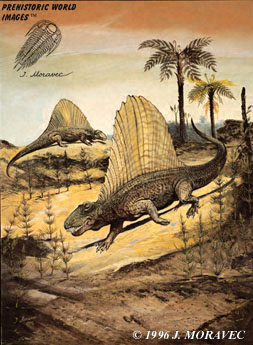
[N]ew research suggests that [the mass extinction] was followed by an explosion of complexity in marine life, one that has persisted ever since.I know, I know. The Dimetrodon was not a marine life form. But damn, they look cool.Moreover, it happened quite suddenly, according to the study, which was led by scientists at the Field Museum of Natural History in Chicago and published in the current issue of the journal Science. The shift to complicated, interrelated ecosystems was more like a flip of a switch than a slow trend.
The researchers detected the change by analyzing records of marine fossils from 1,176 sites around the world, which are part of a new international archive, the Paleobiology Database (pbdb.org).
They found that marine life before the biggest global die-off, the Permo-Triassic extinction, was evenly split into two types of communities: simple ones, in which most species were anchored in place and got by without interacting with neighbors (like eating them or being eaten by them), and complex ones, with many interrelationships.
But since then, complex communities filled with grazers, scavengers, predators, burrowers and other mobile creatures have been three times as common as simple ones, said Peter J. Wagner, the lead author of the study.
The shift essentially took the oceans from a norm in which anchored (or sessile) creatures, including brachiopods and sea lilies, filtered food carried in currents to one dominated by roaming (or motile) fauna like snails, urchins and crabs.
Dr. Wagner said it was not clear why this particular extinction spasm had this permanent effect on the character of communities, while others did not.
A 2002 study led by Richard K. Bambach, an emeritus professor at Virginia Tech, found the general shift to a higher abundance of motile fauna from the early Triassic Period onward, but it did not examine patterns in individual communities.
But Dr. Wagner said motility was an enduring characteristic of the more variegated biological webs.
“The increased diversity of mobile species would have contributed to more complex ecological communities,” he said. “With sessile guys, everybody is just living next to one another and that’s it. With mobility and higher metabolism, you bump into each other more often, both literally and figuratively, and you end up with a greater number of potential interactions.”
posted by Jude at 12:55 PM

posted by Jude at 2:08 PM

Across the eastern United States, a gruesome ritual is in full swing. The praying mantis and its relative, the Chinese mantis, are in their courtship season. A male mantis approaches a female, flapping his wings and swaying his abdomen. Leaping on her back, he begins to mate. And quite often, she tears off his head.
The female mantis devours the head of the still-mating male and then moves on to the rest of his body. “If you put a pair together and come back later, you’ll just find the wings of the male and no other evidence he was ever there,” said William Brown, an evolutionary biologist at the State University of New York in Fredonia.
--snip--
Some sexual cannibals, including female Chinese mantises, actually eat a lot of males. “One study estimated that 63 percent of the diet of females are male mantids,” Dr. Brown said. “So they’re the main food source.”
posted by Jude at 11:41 AM

Labels: nerd shit
posted by Jude at 3:40 PM


