I've Got Some Bad News, and I've Got Some Good News (Brief Edition)


First, the bad news.
However, you don't have to be depressed about it.
Labels: Climate change, Drugs, nerd shit, Science
posted by Jude at 7:14 PM

Gumbo and Beignets
Labels: Climate change, Drugs, nerd shit, Science
posted by Jude at 7:14 PM

The European Space Agency (ESA) on Tuesday called for applications for one of the most demanding human experiments in space history: a simulated trip to Mars in which six "astronauts" will spend 17 months in an isolation tank on Earth.
Their spaceship will comprise a series of interlocked modules in an research institute in Moscow, and once the doors are closed tight, the volunteers will be cut off from all contact with the outside world except by a delayed radio link.
They will face simulated emergencies, daily work routines and experiments, as well as boredom and, no doubt, personal friction from confinement in just 550 cubic metres (19,250 cubic feet), the equivalent of nine truck containers.
Communications with the simulated mission control and loved-ones will take up to 40 minutes, the time that a radio signal takes to cross the void between Earth and a spaceship on Mars. Food will comprise mainly the packaged stuff of the kind eaten aboard the
International Space Station (ISS).
The goal is to gain experience about the psychological challenges that a crew will face on a trip to Mars.
Four of the crew will be Russian, and two will come from countries that are members of ESA, agency and Russian officials said at the Paris Air Show in Le Bourget.
In all, 12 European volunteers are needed.
A precursor 105-day study is scheduled to start by mid-2008, possibly followed by another 105-day study, before the full 520-day study begins in late 2008 or early 2009.
--snip--
The terrestrial Mars-stronauts will not get much glory for their confinement, nor will they get particularly rich.
They will get paid 120 euros (158 dollars) a day, said Marc Heppener of ESA's Science and Application Division.
posted by Jude at 11:38 AM

posted by Jude at 10:07 AM

US researchers have identified microscopic traces of soft tissue taken from a 68 million-year-old T-rex fossil in a startling discovery that is yielding clues to evolutionary links between dinosaurs and birds, a study released Thursday said.Sixty-eight million year old soft tissue? Amazing.
The tiny protein fragments were extracted from the leg bone of a Tyrannosaurus rex that was discovered in the western state of Montana in 2003, but it wasn't until recently that scientists were able to definitively identify them as traces of prehistoric dinosaur collagen.
The collagen should have degraded millions of years before according to conventional wisdom, but paleontologists at North Carolina State University were fairly confident that what they had was the "barely detectable" remains of dinosaur soft tissue based on their chemical and molecular analyses.
However, they could not definitively say that, so they turned to biochemist John Asara at Beth Israel Deaconess Medical School in Boston to make that determination.
It took Asara a year and a half, but he was finally able to sequence the amino acids in the collagen proteins - a proxy for DNA analysis - and conclude that the T-rex femur did indeed contain traces of collagen, a fibrous protein found in bone.
When the researchers compared those amino acid sequences to those of similar proteins in several contemporary animals, they found that the T-rex sequence had similarities to those of chickens, and to a lesser extent frogs and newts.
That finding bolsters a recent and controversial proposal that birds and dinosaurs are evolutionarily related, and change that hypothesis to a theory, the researchers said.
posted by Jude at 1:02 PM

posted by Jude at 9:55 AM


posted by Jude at 2:46 PM


Labels: Eschatology, nerd shit, Science
posted by Jude at 1:11 PM

posted by Jude at 2:46 PM

Scientists have discovered a large area thousands of square kilometres in extent in the middle of the Atlantic where the Earth’s crust appears to be missing. Instead, the mantle - the deep interior of the Earth, normally covered by crust many kilometres thick - is exposed on the seafloor, 3000m below the surface.Where could it be?
Marine geologist Dr Chris MacLeod, School of Earth, Ocean and Planetary Sciences said: "This discovery is like an open wound on the surface of the Earth. Was the crust never there? Was it once there but then torn away on huge geological faults? If so, then how and why?"
To answer some of these questions Dr MacLeod with a team of scientists, led by marine geophysicist Professor Roger Searle, Durham University, will travel to the area which lies mid-way between the Cape Verde Islands and the Caribbean.
posted by Jude at 3:03 PM

Recent observations of the polar regions in 2006 have prompted alarm from experts that ice melting rates could be exceeding even IPCC projections.Can we finally fucking do something about this already?
The latest measurements show that Arctic sea-ice masses last year nearly matched lows recorded in 2005 and that for the first time re-freezing delayed until late autumn.
Unexpected breakage and movement of large pieces of Arctic coastal ice have also been reported as well as significant and surprising warming of ocean surface waters entering the Arctic from the North Atlantic.
Detailed observations of unpredicted networks of lakes and connection channels under the Antarctic ice sheet, and evidence of recent fast flows in some of those channels, have been published in the past few months, as have recent observations of unexpected discharge and depletion rates of some Greenland glaciers.
Dr Carlson added: “These and other changes in physical and ecological systems of polar regions, all observed over the past two years indicate a region undergoing rapid change and in need of comprehensive attention.”
In its report, IPCC Working Group I said that sea ice is projected to shrink in both Arctic and Antarctic regions and that large areas of the Arctic Ocean could lose year-round ice cover by the end of the 21st century if human emissions reach the higher end of current estimates.
The extent of Arctic sea ice has already shrunk by about 2.7% per decade since 1978, with the summer minimum declining by about 7.4% per decade according to the report.
Labels: Climate change, Politics, Science
posted by Jude at 3:31 PM

posted by Jude at 1:16 PM

posted by Jude at 10:56 PM

CHESTER, England - In an evolutionary twist, Flora the Komodo dragon has managed to become pregnant all on her own without any male help. She is carrying seven baby Komodo dragons.Fuckin' killjoy herpetologist.
"We were blown away when we realized what she'd done," said Kevin Buley, a reptile expert at Flora's home at the Chester Zoo in this town in northern England. "But we certainly won't be naming any of the hatchlings Jesus."
posted by Jude at 6:31 PM
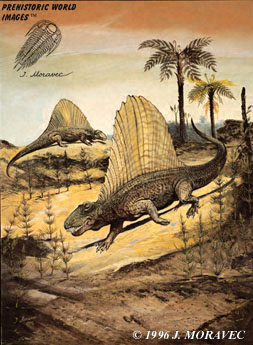
[N]ew research suggests that [the mass extinction] was followed by an explosion of complexity in marine life, one that has persisted ever since.I know, I know. The Dimetrodon was not a marine life form. But damn, they look cool.Moreover, it happened quite suddenly, according to the study, which was led by scientists at the Field Museum of Natural History in Chicago and published in the current issue of the journal Science. The shift to complicated, interrelated ecosystems was more like a flip of a switch than a slow trend.
The researchers detected the change by analyzing records of marine fossils from 1,176 sites around the world, which are part of a new international archive, the Paleobiology Database (pbdb.org).
They found that marine life before the biggest global die-off, the Permo-Triassic extinction, was evenly split into two types of communities: simple ones, in which most species were anchored in place and got by without interacting with neighbors (like eating them or being eaten by them), and complex ones, with many interrelationships.
But since then, complex communities filled with grazers, scavengers, predators, burrowers and other mobile creatures have been three times as common as simple ones, said Peter J. Wagner, the lead author of the study.
The shift essentially took the oceans from a norm in which anchored (or sessile) creatures, including brachiopods and sea lilies, filtered food carried in currents to one dominated by roaming (or motile) fauna like snails, urchins and crabs.
Dr. Wagner said it was not clear why this particular extinction spasm had this permanent effect on the character of communities, while others did not.
A 2002 study led by Richard K. Bambach, an emeritus professor at Virginia Tech, found the general shift to a higher abundance of motile fauna from the early Triassic Period onward, but it did not examine patterns in individual communities.
But Dr. Wagner said motility was an enduring characteristic of the more variegated biological webs.
“The increased diversity of mobile species would have contributed to more complex ecological communities,” he said. “With sessile guys, everybody is just living next to one another and that’s it. With mobility and higher metabolism, you bump into each other more often, both literally and figuratively, and you end up with a greater number of potential interactions.”
posted by Jude at 12:55 PM

posted by Jude at 2:08 PM

LAUER: And you brought up Michael J. Fox. Let me just ask you: You know, Rush Limbaugh started a lot of controversy when he said perhaps Michael J. Fox was exaggerating or faking these effects of Parkinson's disease in that ad promoting stem cell research. Didn't Rush Limbaugh just say what a lot of people were privately thinking?Well, gee, Matt. He might have said what you were thinking, but don't project that sick shit onto the rest of us.

posted by Jude at 3:19 PM

European scientists voiced shock today as they viewed pictures which showed Arctic ice cover had disappeared so much last month that a ship could sail unhindered from Europe's most northerly outpost to the North Pole.
The satellite images were acquired from August 23 to 25 by instruments aboard Envisat and EOS Aqua, two satellites operated by the European Space Agency (ESA).
Perennial sea ice – thick ice that is normally present year-round and is not affected by the Arctic summer – had disappeared over an area bigger than the British Isles, ESA said.
Vast patches of ice-free sea stretched north of Svalbard, an archipelago lying midway between Norway and the North Pole, and extended deep into the Russian Arctic all the way to the North Pole, the agency said in a press release.
"This situation is unlike anything observed in previous record low-ice seasons," said Mark Drinkwater of ESA's Oceans/Ice Unit.
"It is highly imaginable that a ship could have passed from Spitzbergen or Northern Siberia through what is normally pack ice to reach the North Pole without difficulty."
Spitzbergen is one of the Svalbard islands, which are Norwegian.
"If this anomaly continues, the Northeast Passage – or Northern Sea Route between Europe and Asia – will be open over longer intervals of time, and it is conceivable we might see attempts at sailing around the world directly across the summer Arctic Ocean within the next 10 to 20 years," Drinkwater said.
The images are for late summer. In the last weeks, what was open water has begun to freeze, as the autumn air temperatures over the Arctic begin to fall, ESA said.
Regular satellite monitoring over the past 25 years shows the northern polar ice cover has shrunk and thinned as global temperatures have risen.
Labels: Climate change, Science
posted by Jude at 11:36 AM

Across the eastern United States, a gruesome ritual is in full swing. The praying mantis and its relative, the Chinese mantis, are in their courtship season. A male mantis approaches a female, flapping his wings and swaying his abdomen. Leaping on her back, he begins to mate. And quite often, she tears off his head.
The female mantis devours the head of the still-mating male and then moves on to the rest of his body. “If you put a pair together and come back later, you’ll just find the wings of the male and no other evidence he was ever there,” said William Brown, an evolutionary biologist at the State University of New York in Fredonia.
--snip--
Some sexual cannibals, including female Chinese mantises, actually eat a lot of males. “One study estimated that 63 percent of the diet of females are male mantids,” Dr. Brown said. “So they’re the main food source.”
posted by Jude at 11:41 AM
Scientists Question Nature's Fundamental LawsWow.
Public confidence in the "constants" of nature may be at an all time low. Recent research has found evidence that the value of certain fundamental parameters, such as the speed of light or the invisible glue that holds nuclei together, may have been different in the past.
"There is absolutely no reason these constants should be constant," says astronomer Michael Murphy of the University of Cambridge. "These are famous numbers in physics, but we have no real reason for why they are what they are."
The observed differences are small-roughly a few parts in a million-but the implications are huge: The laws of physics would have to be rewritten, not to mention we might need to make room for six more spatial dimensions than the three that we are used to.
Lines of evidence
The evidence for varying constants focuses primarily on quasar studies.
Quasars are extremely luminous objects, powered by giant black holes. Some of them are so far away that their light was emitted 12 billion years ago.
Astronomers study the spectra of this ancient light to determine if the early universe was different than now. Specifically, they look at absorption lines, which are due to gas clouds between us and the quasars.
The lines reveal exactly what is in the clouds, since each type of atom has a "fingerprint"-a set of specific frequencies at which it absorbs.
In 1999, Murphy and his colleagues found the first convincing evidence that these fingerprints change with time. Using data from the Keck observatory in Hawaii, they detected a frequency difference between billion-year-old quasar lines and the corresponding lines measured on Earth.
Some of these Earth-bound lines were not well characterized, so Murphy and others recently performed careful lab experiments to confirm that there is indeed a shift in the quasar spectra. A spectra is basically light split into its component frequencies, much like when white light goes through a prism to produce a rainbow.
What's in a constant
Because the frequencies of absorption lines depend on various parameters, the quasar observations are sometimes interpreted as indicating that light was faster in the past, or that the electron had a weaker charge.
But theorist Carlos Martins of the University of Cambridge tells LiveScience that this is not entirely correct: "It doesn't make sense to talk about a varying speed of light or electron charge."
This is because the values of these parameters include units that might change. The speed of light, for instance, might be measured one day with a ruler and a clock. If the next day the same measurement gave a different answer, no one could tell if the speed of light changed, the ruler length changed, or the clock ticking changed.
To avoid this confusion, scientists use dimensionless constants-pure numbers that are ratios of measured quantities.
In the case of the shifts in Murphy's data, the relevant dimensionless constant is the fine structure constant (often designated by the Greek letter alpha), which characterizes the strength of the electromagnetic force.
The researchers found that alpha was smaller in the past, but other "famous numbers" would not be immune to the vagaries of time.
"You would expect variation in all the fundamental constants," Murphy says.
It was therefore not entirely a surprise when-in April of this year-Patrick Petitjean of the Astrophysical Institute of Paris and his collaborators detected a change in the proton to electron mass ratio from molecular absorption lines in quasar spectra.
The mass variation can be interpreted as the strong force's coupling constant being larger in the early universe, Petitjean says.
A hole in the theory
Time-varying constants of nature violate Einstein's equivalence principle, which says that any experiment testing nuclear or electromagnetic forces should give the same result no matter where or when it is performed.
If this principle is broken, then two objects dropped in a gravitational field should fall at slightly different rates. Moreover, Einstein's gravitational theory-general relativity-would no longer be completely correct, Martins says.
A popular alternative to relativity, which assumes that sub-atomic particles are vibrating strings and that the universe has 10 or more spatial dimensions, actually predicts inconstant constants.
According to this string theory, the extra dimensions are hidden from us, but the "true" constants of nature are defined on all dimensions. Therefore, if the hidden dimensions expand or contract, we will notice this as a variation in our "local" 3D constants.
Even if string theory is not correct, the current model of gravity will likely need to be revised to unite it with the other three fundamental forces.
"We have an incomplete theory, so you look for holes that will point to a new theory," Murphy says. Varying constants may be just such a hole.

posted by Jude at 4:59 PM

The storm was nothing special. Its waves rocked the Norwegian Dawn just enough so that bartenders on the cruise ship turned to the usual palliative — free drinks.To hell with a bunch of oceanographers. They sound like a horde of desk-bound dipshits who think that when they fart in the bathtub that's a rough sea. Bunch of non-salty jerks.
Then, off the coast of Georgia, early on Saturday, April 16, 2005, a giant, seven-story wave appeared out of nowhere. It crashed into the bow, sent deck chairs flying, smashed windows, raced as high as the 10th deck, flooded 62 cabins, injured 4 passengers and sowed widespread fear and panic.
“The ship was like a cork in a bathtub,” recalled Celestine Mcelhatton, a passenger who, along with 2,000 others, eventually made it back to Pier 88 on the Hudson River in Manhattan. Some vowed never to sail again.
Enormous waves that sweep the ocean are traditionally called rogue waves, implying that they have a kind of freakish rarity. Over the decades, skeptical oceanographers have doubted their existence and tended to lump them together with sightings of mermaids and sea monsters.
But scientists are now finding that these giants of the sea are far more common and destructive than once imagined, prompting a rush of new studies and research projects. The goals are to better tally them, understand why they form, explore the possibility of forecasts, and learn how to better protect ships, oil platforms and people.
The stakes are high. In the past two decades, freak waves are suspected of sinking dozens of big ships and taking hundreds of lives. The upshot is that the scientists feel a sense of urgency about the work and growing awe at their subjects.
“I never met, and hope I never will meet, such a monster,” said Wolfgang Rosenthal, a German scientist who helped the European Space Agency pioneer the study of rogue waves by radar satellite. “They are more frequent than we expected.”
Drawing on recent tallies and making tentative extrapolations, Dr. Rosenthal estimated that at any given moment 10 of the giants are churning through the world’s oceans.
In size and reach these waves are quite different from earthquake-induced tsunamis, which form low, almost invisible mounds at sea before gaining height while crashing ashore. Rogue waves seldom, if ever, prowl close to land.
“We know these big waves cannot get into shallow water,” said David W. Wang of the Naval Research Laboratory, the science arm of the Navy and Marine Corps. “That’s a physical limitation.”
By one definition, the titans of the sea rise to heights of at least 25 meters, or 82 feet, about the size of an eight-story building. Scientists have calculated their theoretical maximum at 198 feet — higher than the Statue of Liberty or the Capitol rotunda in Washington. So far, however, they have documented nothing that big. Large rogues seem to average around 100 feet.
Most waves, big and small alike, form when the wind blows across open water. The wind’s force, duration and sweep determine the size of the swells, with big storms building their height. Waves of about 6 feet are common, though ones up to 30 or even 50 feet are considered unexceptional (though terrifying to people in even fairly large boats). As waves gain energy from the wind, they become steeper and the crests can break into whitecaps.
The trough preceding a rogue wave can be quite deep, what nautical lore calls a “hole in the sea.” For anyone on a ship, it is a roller coaster plunge that can be disastrous.
Over the centuries, many accounts have told of monster waves that battered and sank ships. In 1933 in the North Pacific, the Navy oiler Ramapo encountered a huge wave. The crew, calm enough to triangulate from the ship’s superstructure, estimated its height at 112 feet.
In 1966, the Italian cruise ship Michelangelo was steaming toward New York when a giant wave tore a hole in its superstructure, smashed heavy glass 80 feet above the waterline, and killed a crewman and two passengers. In 1978, the München, a German barge carrier, sank in the Atlantic. Surviving bits of twisted wreckage suggested that it surrendered to a wave of great force.
Despite such accounts, many oceanographers were skeptical. The human imagination tended to embellish, they said.

Labels: Nautical shit, nerd shit, Science
posted by Jude at 12:36 PM


